
Step By Step Music
Private Music Lessons Online
Music Theory
You know when it sounds good...
But do you know WHY?
🧠
Ready to test your knowledge?
Take these assessments to see where you're at!
💻
Download PDFs to go with my videos
How to Build Chords
Theory Lesson for Beginners
This lesson explains the basics of chords, including what they are, how they are constructed, and how they relate to scales and keys. Understanding chords is essential for playing, composing, and analyzing music.
WHAT IS A CHORD
A chord consists of multiple notes played simultaneously. Playing notes harmonically means sounding them all at once, while playing them melodically means playing them one at a time. A chord can also be “implied” when its notes are present but not played together.
WHERE DO CHORDS COME FROM
Chords are derived from scales, which are sequences of notes separated by whole steps and half steps. The major scale is the standard reference. A major chord uses the 1st, 3rd, and 5th notes from the major scale. Minor chords, sometimes called natural minor, are created by altering the 3rd degree of the major scale to produce a 1–b3–5 pattern.
MAJOR AND MINOR CHORDS
Major chords generally sound bright and stable, while minor chords produce a darker or more somber tone. Learning to identify the notes in any major or minor chord helps in playing, composing, and understanding music theory. Triads—three-note chords—are the foundation of most harmonic structures in Western music.
CHORDS AND KEYS
Chords fit into keys based on scale degrees. Each chord can be labeled with numbers corresponding to its position in the scale. Roman numerals are used to indicate chord functions within a key, distinguishing major and minor chords (e.g., I, IV, V for major; ii, iii, vi for minor).
USING CHORDS IN PRACTICE
Understanding chord construction and relationships helps you play harmonically, compose melodies, and analyze music. All chords can be thought of as a set of numbers derived from the scale, allowing you to transpose, improvise, and harmonize in any key.
Modes: The Final Answer
Understand Modes on Any Instrument
Modes?! Right? Not anymore! In this lesson, you’ll finally understand and embrace modes once and for all. I’ll show you what modes really are, how they’re used, and how to memorize them so they actually make sense. Perfect for bass and guitar players who want to unlock the fretboard and make better musical decisions with confidence.
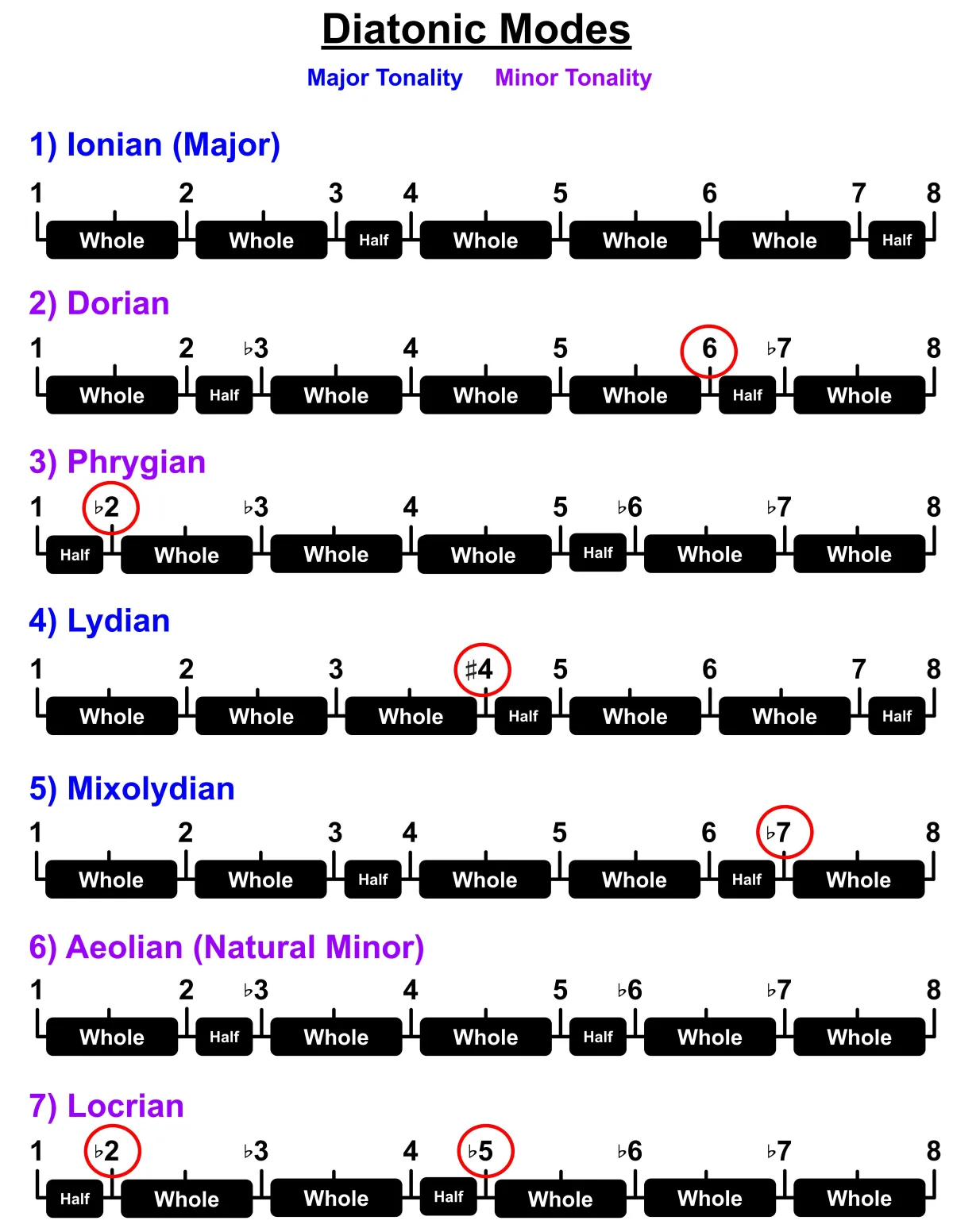
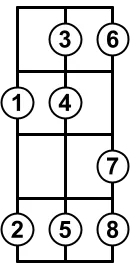
Scale Degrees for Bass and Guitar:
Taking the Mystery Out of Music Theory
Confused by scale degrees? Don’t worry—this lesson makes it easy! You’ll learn exactly what scale degrees are, how they’re used, and why they’re one of the most important concepts in all of music theory. I’ll show you how numbering the notes of the major scale helps you understand chords, progressions, and melodies on any instrument—especially bass and guitar. Once you understand scale degrees, you’ll be able to see the full picture of how music fits together and start making smarter musical choices every time you play.
Music Theory in Plain English:
Understanding Diminished 7 Chords
Diminished chords can seem confusing—but only until you understand them! In this beginner-friendly lesson, I’ll break down what a diminished 7 chord really is, where it comes from, and why it sounds the way it does. You’ll learn the simple theory behind this powerful chord type and how to recognize it on your bass or guitar. By the end, you’ll have a clear foundation that makes future lessons on diminished chords easy to follow and fun to play.
Need help?
Have questions?
What else do you want to learn today?
NEW!
Practice with me, and find out how to make the MOST of your time

